We want water, not assurances
Sunday June 3, 2007
I BELIEVE many residents, including myself, will be grateful if The Star can highlight the water woes in the Cameron Highlands.
Since the morning of May 30, the taps have run dry. On May 31, except for a brief period (9am-9.30am) there was no water to wash, bathe, clean, cook, etc.
It was just two months ago that the Pahang water dept director was quoted in your newspaper as saying water woes in Cameron Highlands will be a thing of the past now that the Kuala Terla dam is operational.
We don't want assurances, what we need is water.
Khoo Kheng-Hor,
Cameron Highlands, Pahang.
--The Star. Opinion.
Sunday, June 03, 2007


Sunday, May 27, 2007
The best places to go
The best places to go
Sunday May 27, 2007
FROM the various beautiful islands and hill resorts around the country to shopping complexes and even Pizza Hut restaurants, there were certainly a wide variety of destinations students love to visit in Malaysia.
Entries for the C4R: The Place to Go contest proved that islands like Langkawi, Redang and Tioman were the most popular destinations, followed closely by Taman Negara, hill resorts like Cameron Highlands and Genting Highlands, as well as Kuala Lumpur.
Other entries highlighted lesser-known attractions like Rawa Island in Johor and the fireflies in Nibong Tebal, Penang.
Some students proved that there's no place like home with their favourite destinations being their kampung or grandma's house.
A special thanks goes out to English teacher P. Vinothani for sending in the highest number of entries for this contest – 64 entries from her school, SMK Seksyen 1 Bandar Kinrara, Selangor.
Although we received many creative and convincing entries, unfortunately, we can only award the best 15 students with Pizza Hut vouchers worth RM100 (see table).
Congratulations to the winners! Look out for your Pizza Hut vouchers in the mail.
This is the final monthly contest organised by Star-NiE and Pizza Hut for the year. The focus now shifts to our annual nationwide contest, Campaign 4 Rewards (C4R) 2007, which was launched on May 8.
More delicious pizzas and great prizes await both students and teachers in this contest!
The Star-NiE pullout and Stuff@school are published every Wednesday during the school year. The two pullouts come free with the daily paper exclusively to schools that subscribe to The Star.
Schools interested in ordering the paper at a special price can call The Star’s customer care unit at 03-7967 1777 from Monday to Friday, between 9am and 5pm. -- The Star.
Saturday, May 19, 2007
Book errant farmers for using excesive banned chemicals
Minister: Book errant farmers
Saturday May 19, 2007
MUAR: Take action against them – that is Agriculture and Agro-Based Industries Minister Tan Sri Muhyiddin Yassin's message to the authorities for farmers who have admitted to using excessive or banned chemicals.
“We are very concerned with any excessive use of pesticides or any banned chemicals on our greens. If farmers have admitted to using them, they should be booked,” he said.
He was speaking to reporters after attending a Maulidur Rasul function in Kampung Hujung Tambak, Grisek, near here, on Thursday night.
Muhyiddin said it was shocking that some farmers were willing to admit using or importing banned chemicals.
“We have laws and regulations and the Health Ministry can enforce the laws,” he said.
On the issue of fake guava-apple hybrids highlighted by the Consumers Association of Penang, Muhyiddin said the matter should not arise because it was against the law for anyone to use dangerous artificial colouring on their products.
He said the farmers might not be involved in making such hybrid fruits but some other parties could have done so and sold them to visitors at Cameron Highlands.
“We will investigate the claim and I want samples of the hybrid fruits to be tested for dangerous chemicals before we can act on the producers,” he added. -- The Star
Thursday, May 17, 2007
DID duo claim trial to CBT
DID duo claim trial to CBT
Thursday May 17, 2007
KUANTAN: An engineer and a senior technician with the Cameron Highlands Drainage and Irrigation Department (DID) have claimed trial in the Sessions Court here to a criminal breach of trust case involving RM115,560.
Mohd Jais Sulaiman, 43, of Bandar Indera Mahkota, and Abdul Mokhtar Othman, 56, of Bera, are said to have submitted a false document four years ago for a certificate of practical completion in a contract to build houses and other related work at an orang asli settlement in Sungai Ubi, Ringlet, Cameron Highlands.
In the document, they claimed that the project had been completed on June 26, 2003 and taken possession the following day, when work in fact had yet to be completed.
They allegedly submitted the document to the state DID director’s office in Kuantan on Sept 12, 2003, with the intention to claim the last interim payment of RM115,560.
The offence carries a jail term of up to 20 years, a fine of five times the amount involved or RM10,000, whichever is higher.
Judge Ahmad Zamzani Mohd Zain granted bail at RM1,500 each and ordered both accused to surrender their passports.
He also fixed June 18 for re-mention. -- The Star.
Tuesday, May 15, 2007
Fake guava-apples being sold
Fake guava-apples being sold
Tuesday May 15, 2007
PENANG: Fake guava-apple hybrids are being sold openly at fruit stalls in Cameron Highlands.
Consumers Association of Penang (CAP) president S.M. Mohamed Idris said the so-called hybrids posed a potential health threat to the people because of the use of artificial colouring.

“It can also taint the country’s image because locals and tourists are fooled into thinking that it is a natural hybrid from Cameron Highlands. There is no such hybrid fruit in Cameron Highlands,” he told a press conference here yesterday.
Mohamed Idris said the fruits were being sold at RM10 per pair.
He said artificial colouring was used to fool the people into thinking that the guavas were jambu-apple hybrids.
He claimed that colouring agents brilliant blue and tartrazine were mixed for the light-green effect while carmoisine was used for red colouring.
Mohamed Idris said studies in Britain had linked tartrazine and carmoisine to temper tantrums, poor concentration, hyperactivity and allergic reaction in youngsters.
He said the Food Standards Agency in Britain had been reviewing the safety of such additives since 2000.
“Although the colouring substances are currently permitted under the (Malaysian) Food Act 1983, we need to question why fresh fruits are allowed to be coloured and modified?” he added.
Mohamed Idris said CAP had received complaints from foreign and local tourists who felt cheated after the fruits went bad within a day or two.
He said CAP wrote to the Cameron Highlands health office and the Domestic Trade and Consumer Affairs Ministry last week.
When contacted, farmers in Cameron Highlands said they were puzzled by claims that the fruits were being sold there.
Indian Farmers Association of Cameron Highlands president P. Viswanathan pointed out that guavas and jambu-apples were not even grown there.
“There is no such thing. If tourists are complaining about these fake hybrids, the Consumers Association of Penang should show proof,” he said.
Federation of Vegetable Farmers Association secretary Chay Ee Mong also said the claims were “news to him,” adding that the problem might have started from fruit hawkers, not the farmers. -- Bernama.
Tuesday May 15, 2007
PENANG: Fake guava-apple hybrids are being sold openly at fruit stalls in Cameron Highlands.
Consumers Association of Penang (CAP) president S.M. Mohamed Idris said the so-called hybrids posed a potential health threat to the people because of the use of artificial colouring.

Fruity concern: Mohamed Idris showing fruits that are supposed to be guava-apple hybrids in Penang yesterday. — Bernama
“It can also taint the country’s image because locals and tourists are fooled into thinking that it is a natural hybrid from Cameron Highlands. There is no such hybrid fruit in Cameron Highlands,” he told a press conference here yesterday.
Mohamed Idris said the fruits were being sold at RM10 per pair.
He said artificial colouring was used to fool the people into thinking that the guavas were jambu-apple hybrids.
He claimed that colouring agents brilliant blue and tartrazine were mixed for the light-green effect while carmoisine was used for red colouring.
Mohamed Idris said studies in Britain had linked tartrazine and carmoisine to temper tantrums, poor concentration, hyperactivity and allergic reaction in youngsters.
He said the Food Standards Agency in Britain had been reviewing the safety of such additives since 2000.
“Although the colouring substances are currently permitted under the (Malaysian) Food Act 1983, we need to question why fresh fruits are allowed to be coloured and modified?” he added.
Mohamed Idris said CAP had received complaints from foreign and local tourists who felt cheated after the fruits went bad within a day or two.
He said CAP wrote to the Cameron Highlands health office and the Domestic Trade and Consumer Affairs Ministry last week.
When contacted, farmers in Cameron Highlands said they were puzzled by claims that the fruits were being sold there.
Indian Farmers Association of Cameron Highlands president P. Viswanathan pointed out that guavas and jambu-apples were not even grown there.
“There is no such thing. If tourists are complaining about these fake hybrids, the Consumers Association of Penang should show proof,” he said.
Federation of Vegetable Farmers Association secretary Chay Ee Mong also said the claims were “news to him,” adding that the problem might have started from fruit hawkers, not the farmers. -- Bernama.
Friday, May 11, 2007
Agency to import chillies
Agency to import chillies
Friday May 11, 2007
THE Federal Agriculture Marketing Au-thority (Fama) will import red chillies to overcome a shortage in Penang.
Deputy Agriculture and Agro-based Indus-try Minister Datuk Seri Mohd Shariff Omar said Penang was the only state facing a shortage of red chillies.
“Fama will import chillies from Thailand and Indonesia by this week. The local supply of chillies has been lower than usual due to the weather,” he said after presenting aid from the Poor Students Trust Fund to 10 schools in tasik Gelugor yesterday.
He said Penang got its supply of chillies from Ipoh and the Cameron Highlands but the harvest had been poor due to rainy weather.
“There had also been a 50% increase in de-mand for chillies during April and May as a result of the festive season,” Mohd Shariff said.
He said the price of the chillies in Penang had risen to RM15 per kg compared to its usual price of RM7 to RM8 per kg due to the shortage.
He said the Domestic Trade and Consumer Affairs Ministry received a complaint yesterday that the price of chillies had shot up.
“They will send their officers to check and monitor the situation closely,” Mohd Shariff added.
The Consumers Association of Penang said in a statement yesterday that housewives had complained that three chillies in Penang markets now cost RM1.50 which was more expensive that a packet of nasi lemak. -- The Star.
Wednesday, May 09, 2007
Farmers admit misuse
CAP: Farmers admit misuse
By Clara Chooi
Wednesday May 9, 2007
CAMERON HIGHLANDS: Up to 90% of the over 4,000 farmers here use banned pesticides on their crops.
This was admitted by a group of farmers here yesterday during a press conference held by the Consumers Association of Penang (CAP).
“It is a known practice. We use it because it is more effective than the permitted pesticides,” said one farmer, who refused to be named.
However, he said the farmers usually stop using the dangerous chemicals on their crops whenever it was close to harvesting time.
“We spray the pesticides once a week during the three-month period while our crops our growing. About a month before harvest, we switch to the permitted pesticides,” said another farmer.

The farmers said that the banned pesticides could be bought from local agents who get their stocks from Thailand.
There are about 15 types of such pesticides including the brands of Super Mac, Lannete, Naporex and Vertimec, which cost between RM25 and RM350, depending on weight and quality.
According to the farmers, at least 70% of the crops were being consumed by Malaysians while the rest were exported to Singapore.
However, they said that the crops for export would be treated with fewer pesticides and would be washed thoroughly before they were packed.
“That is why the Singaporeans are still buying our crops,” said CAP education officer N.V. Subbarow.
He was commenting on Deputy Agriculture and Agro-based Industries Minister Datuk Mah Siew Keong’s recent statement that if local crops contained dangerous pesticides, Singapore would have stopped importing them. -- The Star.
By Clara Chooi
Wednesday May 9, 2007
CAMERON HIGHLANDS: Up to 90% of the over 4,000 farmers here use banned pesticides on their crops.
This was admitted by a group of farmers here yesterday during a press conference held by the Consumers Association of Penang (CAP).
“It is a known practice. We use it because it is more effective than the permitted pesticides,” said one farmer, who refused to be named.
However, he said the farmers usually stop using the dangerous chemicals on their crops whenever it was close to harvesting time.
“We spray the pesticides once a week during the three-month period while our crops our growing. About a month before harvest, we switch to the permitted pesticides,” said another farmer.

Unsafe: Subbarow showing reporters on Tuesday some samples of the banned pesticides that farmers in Cameron Highlands have admitted using on their crops.
The farmers said that the banned pesticides could be bought from local agents who get their stocks from Thailand.
There are about 15 types of such pesticides including the brands of Super Mac, Lannete, Naporex and Vertimec, which cost between RM25 and RM350, depending on weight and quality.
According to the farmers, at least 70% of the crops were being consumed by Malaysians while the rest were exported to Singapore.
However, they said that the crops for export would be treated with fewer pesticides and would be washed thoroughly before they were packed.
“That is why the Singaporeans are still buying our crops,” said CAP education officer N.V. Subbarow.
He was commenting on Deputy Agriculture and Agro-based Industries Minister Datuk Mah Siew Keong’s recent statement that if local crops contained dangerous pesticides, Singapore would have stopped importing them. -- The Star.
Monday, May 07, 2007
Fruitful venture for Jia Fu
Fruitful venture for Jia Fu
Focus on SME's : By Rachael Kam
Monday May 7, 2007
Fertiliser producer Jia Fu Enterprise has diversified into the fruit plantation business, which is expected to overtake fertilisers eventually as the main revenue contributor.
OUTSIDE the bustling concrete jungles of Malaysia, small-scale entrepreneurs in the agricultural sector beaver away to grow their businesses.
With the country's population expanding, Jia Fu Enterprise founder and managing director Jason Ong foresees growth in his chosen business.
“The population growth would definitely lead to higher demand for food produced by the industry,” he said.
Ong, a graduate in Accounting and Finance from Australia, founded the company in 2003 mainly to manufacture organic fertilisers for local farmers in the fruit, vegetable and flower plantations.

The Jia Fu plant in Broga, Negri Sembilan, produces 28 tonnes of powder fertilisers and 6,000 litres of liquid fertilisers a month. Its products are currently distributed to local agents and farmers in Perak, Johor, Negri Sembilan, Cameron Highlands and Pahang.
He said agriculture was the main sector in Johor, Perak, Penang and Kedah.
“We expect to have four more agents this year to expand our distribution network,” Ong said.
The 30-year-old inherited the skills and knowledge to produce organic fertilisers from his father, who has been in this business for over a decade. Ong sources chicken feathers from chicken processing factories to process the raw materials into organic fertilisers.
The company used its own fertiliser products at its orchard and small vegetable farm in Broga, he added.
“When our business starts growing steadily, we will appoint more workers and invest about RM30,000 to purchase new manufacturing equipment,” he said in an interview.
The company now has four employees.
Apart from fertilisers, the diligent young entrepreneur has also diversified into fruit plantation on his family-owned land.
The factory and Happy Fruitland fruit orchard on 13 acres are located in Jalan Broga, near Semenyih. It is about 5km away from the renowned Nottingham University campus and near a famous hilltop Chinese temple.
Ong said that within the area, four acres were allocated for dragon fruits and three acres for other fruits like durians, Thai coconuts, pineapples, papayas and rambutans. The remaining area is taken up by its factory and partly for the vegetable farm.
He said the fruits were sold at the farm and sometimes he would sell to the wet market and fruit stalls when there was a surplus.
On future plans, he said: “We plan to lease a 23-acre land at an oil palm estate in Broga, which is 3km away from Happy Fruitland, within two or three years.” This, however, would depend on the financial results and cash flow position, he added.
“The new piece of land is not only for dragon fruits. We also want to cultivate orchids,” Ong said, adding that by then, its agricultural business would contribute more to the company's revenue than fertilisers.
The company is now focusing on its fertiliser business, which contributes about 90% to total sales. Last year, the company recorded a turnover of about RM160,000 compared with RM110,000 in 2005.
“With the increase in the number of agents and customers, we expect revenue to rise 10% to 15% this year,” he said.
He said farmers were gradually changing to organic fertilisers because they found that chemical fertilisers used for the last 10 years had caused the soil to turn hard and this affected the growing of the plants. “Thus, we foresee a strong potential for our products,” he said.
Currently his parents, Ong Kim Tian, 73, and Fong Choi Ping, 53, are helping to run the business whereas Ong focuses more on marketing.
On promotional activities, he said the company had been working with some travel agents who arranged day-trip tours to the orchard. Most of the visitors are from Desa Petaling, Puchong, Sungai Long and Kajang.
There are also kindergartens that bring children there on tours and learning trips. Therefore, the company has made a little fishpond next to the vegetable farm and raised some ducks and chickens in Happy Fruitland. -- The Star Biz.
Saturday, May 05, 2007
Hitting the road
Hitting the road
By Majidah Hashim
Saturday May 5, 2007
Ever wake up on a Saturday morning feeling adventurous? Well, drag the friends out of bed and get a-rollin’.
You do the whole nine-to-five thing all week, so the least you can do for yourself during the weekend is hit the road.
Trust me, it’s the perfect way to de-stress, being out of the city, letting the miles roll by. With the right company, and soundtrack, you could be on your way to a perfect weekend.
Here are five ideas to tease the road trip junkie in you. The best part of it all is that you don’t need a passport!
Idea #1 – Putrajaya
One of the easiest road trips you can do with your family (and camera) is to Putrajaya – and for good reason.
Putrajaya is a living gallery with its abstract and modern sculptures abounding in parks and on the boulevards.
The place is designed with the future in mind. This is reflected not only in its artistic buildings, but its geography and bridges too. Despite being one of the most modern places in the country, Putrajaya has 12 parks to boast of including a botanical park and even wetlands.
Driving to and around Putrajaya is an adventure in itself.
It is located about 45 minutes from Kuala Lumpur and is a labyrinth of surprises. Don’t be afraid to get lost here; the worst you can do is miss an exit and end up among the golden rice fields of Banting, or on the rustic roads of Dengkil.
Either way, it is a trip of interesting panoramas and certainly something to talk about at the office come Monday.
Idea #2 – Ipoh
 A couple of months ago, I found myself negotiating the small roads of southern Perak with a bad map in hand and getting lost. I was on a single lane road that ran through a rubber plantation and an oil palm estate . . .
After what felt like 10km or 20km, the trees gave way to an endless expanse of the most glorious green rice fields I have ever seen. The sun shone brightly overhead and far in the distance I could see tiny wooden village houses.
I made my way from Bidor, through Teluk Intan, and up to Pasir Salak. Along the way, I counted the different fruit orchards I passed. Durians, rambutans (and they were in season too!), bananas, mangoes, pineapple, dragonfruit and whole plantations of coconut trees.
Quite overwhelmed, I felt as if Ipoh welcomed me like an old friend when I finally got there.
Idea #3 – Penang
One weekend, I dragged a bunch of friends in my tiny Perodua Kelisa to Penang!
The festive season madness and the school holiday rampage aside, the North-South Expressway is usually a delightful drive. Stop at the Restoran Jejantas in Sungai Buloh for breakfast, then Tanjung Malim for mid-morning coffee and after that, Tapah for lunch.

As you approach Ipoh, look out for the Lata Kijang waterfalls along the highway as it glistens in the sun.
Before you know it, you’re in Butterworth and at the very edge of the iconic Penang Bridge. Driving around an island is a bit of an adventure. No matter how lost you get, you eventually get to where you want – just that you’ve taken a bit longer to reach.
When you’re about a hundred miles away from everything you are familiar with, it really does not matter where you go or how you get there.
Idea #4 – Kota Baru
Here is an idea for those who are interested in a long weekend break: drive to Simpang Pulai, and from there, take the newly built highway and head towards Cameron Highlands.
This place is always a refreshing place to be, no matter what time of year. Have a spot of tea at the extensive plantations, celebrate with a vegetable steamboat and have some strawberry ice cream for dessert.
Your adventure does not end there. Start early the next morning and wend your way to Gua Musang in Kelantan and then Kota Baru for some fresh seafood on the beach.
The third leg of this road trip is said to be among Peninsular Malaysia’s most scenic drives: a drive on the eastern coastal road.
Traversing Kelantan, Terengganu and Pahang, you will pass quaint fishing villages, makeshift stalls by the beach that sell kampung snacks and mile upon mile of scenic sea and sky all the way to Kuantan.
And anyone knows that when you are in Kuantan, a feast of otak-otak and ikan bakar is in order!
Complete the loop by taking the East-West Expressway from Gambang back to Kuala Lumpur – but don’t forget to stop at Temerloh for some assam tempoyak patin.
Idea #5 – Malacca
Going south for the weekend is a recipe for gridlocks. But, you know what – so what!
I suggest you take the trunk road from Bangi to Nilai (for a secret shopping getaway), and from there to Seremban. Contrary to its somewhat subdued reputation, Seremban transforms into quite the idiosyncratic town over the weekend, which makes for an interesting hunting ground for knick-knacks.
Oh, but don’t stop there. Get back on the road towards Tampin and onwards towards Malacca town.
Hidden among some of the overflowing antique shops at Jonker’s Street are some of the strangest trinkets dating back to early Malaya.
From tiny silk shoes for bound feet, to rust-covered colonial coins, to funky earrings – it’s all here. Even if you end up empty-handed, the experience will be worth remembering. -- The Star Lifestyle.
Saturday, April 14, 2007
Illegal farming in Camerons
286 found to be farming illegally in Camerons
Saturday April 14, 2007
ABOUT 286 people were found to have carried out illegal farming for the past 10 years in Cameron Highlands, Tamil Nesan reported Natural Resources and Environment Minister Datuk Seri Azmi Khalid as saying.
Azmi said the Forestry Department had conducted surprise checks to curb illegal activities there.
Of the 38,271ha of forest reserve in Cameron Highlands, some 166.02ha were found to have been used for illegal farming, he said. -- The Star.
Tragic trip to Cameron Highlands
Sometimes event happens beyond our control. Whatever it is, do take care while traveling for holidays. For self drive, do keep yourself awake while driving long distance and take plenty of breaks to keep oneself refresh. If you are using a bus, then your fate is at the hands of the bus driver.
Holiday trip turns tragic for Singaporeans
Saturday April 14, 2007

KUALA KUBU BARU: A holiday trip turned tragic for a group of Singaporeans when one of them died in a road accident while another sustained injuries.
The tour bus they were travelling in crashed into a lorry at the 418.6 kilometre of the North-South Expressway near Batang Berjuntai, Rawang, at 4.40am yesterday.
One of the bus drivers was also hurt.
The tour bus was transporting 18 passengers and two drivers from Singapore to Cameron Highlands.
Tay Sok Hoon, 53, died on the spot from severe head injuries while Xu Hui Yue, 40, and bus driver, Ng Lee Seng, 46, suffered body injuries.
It is believed that the lorry had overturned after having skidded earlier.
Selangor traffic chief Supt Hussein Omar said the other passengers were unhurt.
“They left Singapore at 10.30pm on Thursday and were supposed to reach Cameron Highlands at 7.30am yesterday. They were to holiday there for four days,'' he added.
Tay's body was taken to the Sungai Buloh Hospital for a post-mortem while the injured passengers were admitted to the emergency ward there.
The lorry driver, Shahrulnizal Ahmad Bakri, 29, who injured his hands, has been detained. -- The Star.
Holiday trip turns tragic for Singaporeans
Saturday April 14, 2007

The damage to the bus that crashed into an overturned lorry near Batang Berjuntai, Rawang, early Friday morning.
KUALA KUBU BARU: A holiday trip turned tragic for a group of Singaporeans when one of them died in a road accident while another sustained injuries.
The tour bus they were travelling in crashed into a lorry at the 418.6 kilometre of the North-South Expressway near Batang Berjuntai, Rawang, at 4.40am yesterday.
One of the bus drivers was also hurt.
The tour bus was transporting 18 passengers and two drivers from Singapore to Cameron Highlands.
Tay Sok Hoon, 53, died on the spot from severe head injuries while Xu Hui Yue, 40, and bus driver, Ng Lee Seng, 46, suffered body injuries.
It is believed that the lorry had overturned after having skidded earlier.
Selangor traffic chief Supt Hussein Omar said the other passengers were unhurt.
“They left Singapore at 10.30pm on Thursday and were supposed to reach Cameron Highlands at 7.30am yesterday. They were to holiday there for four days,'' he added.
Tay's body was taken to the Sungai Buloh Hospital for a post-mortem while the injured passengers were admitted to the emergency ward there.
The lorry driver, Shahrulnizal Ahmad Bakri, 29, who injured his hands, has been detained. -- The Star.
Tuesday, March 27, 2007
Trekkers damaging floral species on Gunung Brinchang
Trekkers damaging floral species on Gunung Brinchang
Tuesday March 27, 2007
By Nik Naizi Husin
CAMERON HIGHLANDS: Located in one of the 17 forest reserve areas in Cameron Highlands, the mossy forest in Batu Gangan on Gunung Brinchang needs to be preserved.
The forest, which is about 1,500m above sea level on the mountain, has been the water catchment area for Cameron Highlands and it lies along the boundary of Pahang-Perak.
As it is the only route for trekkers to Gunung Irau, the forest has been disturbed, causing the demise of some of the floral species in the area including forest orchid, moss, duit-duit, paku pakis, bamboos and paku gajah.

State Arts, Culture, Tourism, Heritage, Women and Family Development Committee chairman Datuk Maznah Mazlan said the state government would provide a 200m long board walk as the platform for trekkers and other visitors to walk over the mossy area.
She it was to reduce the disturbances in the area as some parts were badly affected because of trekking activities.
She said the state Forestry Department had been assigned to design the project, so that the mossy areas of the forest and its surroundings of flora would be intact at all times.
“The mossy area is important to preserve the micro climate and as a water catchment area.
“It is also the place for wildlife and there is also a telecommunications satellite station there,” Maznah said.
She said the area was suitable for bird watching activities.
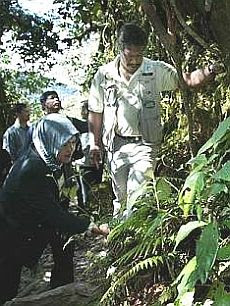
“With all these activities, the mossy forest will be damaged if no efforts were taken to conserve it.
“Packages of tourists visiting here have to be controlled so that the place will not be over-populated in terms of visitors,” she said during her visit here recently.
Other basic amenities needed in the areas were waste bins, parking lots and a guard house for caretakers to control the number of vehicles entering the area and to check on any illegal activities such as the removal of species of flora from the area.
Maznah said some of the popular species in the forest included the periuk kera (pitcher plants) and orchids. -- The Star.
Tuesday March 27, 2007
By Nik Naizi Husin
CAMERON HIGHLANDS: Located in one of the 17 forest reserve areas in Cameron Highlands, the mossy forest in Batu Gangan on Gunung Brinchang needs to be preserved.
The forest, which is about 1,500m above sea level on the mountain, has been the water catchment area for Cameron Highlands and it lies along the boundary of Pahang-Perak.
As it is the only route for trekkers to Gunung Irau, the forest has been disturbed, causing the demise of some of the floral species in the area including forest orchid, moss, duit-duit, paku pakis, bamboos and paku gajah.

Sheen of moss: Trees covered by moss in the forest of Gunong Brinchang at Cameron Highlands.
State Arts, Culture, Tourism, Heritage, Women and Family Development Committee chairman Datuk Maznah Mazlan said the state government would provide a 200m long board walk as the platform for trekkers and other visitors to walk over the mossy area.
She it was to reduce the disturbances in the area as some parts were badly affected because of trekking activities.
She said the state Forestry Department had been assigned to design the project, so that the mossy areas of the forest and its surroundings of flora would be intact at all times.
“The mossy area is important to preserve the micro climate and as a water catchment area.
“It is also the place for wildlife and there is also a telecommunications satellite station there,” Maznah said.
She said the area was suitable for bird watching activities.

Treasure trove: Maznah examining one of the plant species in the forest.
“With all these activities, the mossy forest will be damaged if no efforts were taken to conserve it.
“Packages of tourists visiting here have to be controlled so that the place will not be over-populated in terms of visitors,” she said during her visit here recently.
Other basic amenities needed in the areas were waste bins, parking lots and a guard house for caretakers to control the number of vehicles entering the area and to check on any illegal activities such as the removal of species of flora from the area.
Maznah said some of the popular species in the forest included the periuk kera (pitcher plants) and orchids. -- The Star.
Monday, March 26, 2007
Orang Asli receive medical checks
Free medical checks and advice
Monday March 26, 2007
SOME 350 orang asli of the Batu 10 Jalan Cameron Highlands settlement received free medical checks and advice during a recent health camp.
The health camp was jointly organised by the Obstetrics and Gynaecology Department of Ipoh Hospital, Tapah MCA branch, Lions Club of Tapah Central and the Obstetrical and Gynaecology (O&G) Society of Malaysia.
A total of 17 doctors and 29 medical assistants from the Ipoh Hospital rendered their services at the camp.
Deputy Domestic Trade and Consumer Affairs Minister Datuk S.Veerasingam launched the camp. Also present was Perak MCA Youth secretary Ho You Meng.
Veerasingam said the government was doing its best to help fulfil the social needs of the orang asli community. -- The Star.
Jim Thompson gone without a trace
Gone without a trace
Monday March 26, 2007
By Allan Koay
Jim Thompson’s disappearance in Cameron Highlands 40 years ago remains very much a mystery today.
Moonlight Bungalow. A scenic highland retreat. War-time espionage. A mysterious disappearance. Strangely enough, all these elements in the case of the disappearance of Jim Thompson, known as the Thai silk king, could have been the perfect ingredients for a hardboiled, noir crime novel written by that other Jim Thompson, the American pulp fiction writer.
Indeed, the real-life case is as intriguing as any crime thriller, and still piques interest even today.
 This year marks the 40th anniversary of Thompson’s disappearance in Cameron Highlands. The case remains as densely shrouded in mystery as it was in 1967.
Back then, the high-profile case drew frenzied media attention, leading to speculation about how and why Thompson had vanished without a trace.
Thompson, who had made a name for himself by reviving the ailing Thai silk industry, had come to Cameron Highlands from Bangkok in March that year, travelling with a companion named Constance Mangskau. Both of them met up with Singapore businessman Dr T.G. Ling and his wife, Helen, for a holiday at Moonlight Bungalow, which was then owned by the doctor.
Moonlight Bungalow is located on a hill which, today is reachable via a narrow road that branches off from the main road to the Strawberry Park Resort Hotel.
Thompson was generally known to be a warm and friendly person. But on the day that he decided to take that fateful stroll into the jungle, never to reappear, he was reportedly irritable and quite unlike his usual self.
When Thompson failed to return by dinnertime, his friends became alarmed and feared that something was amiss.
A search party of hundreds – comprising the Malaysian field police, orang asli trackers and the army – was quickly mobilised, and it fanned out across the jungle on both sides of the path that Thompson had taken. Later, American military helicopters were also sent from the US airbases in Thailand to help in the search, which went on for weeks.
When nothing had turned up by then, talk started brewing. Some people believed Thompson had fallen off a ravine, while others thought he had probably been eaten by a tiger. But these were hard to believe as Thompson was an experienced trekker and had had training in jungle warfare. He could not have simply got lost, either.
CIA connection?
Yet others theorised that he had been kidnapped by rival businessmen. There was also speculation fuelled by his involvement in the US Operation Special Service (OSS) during World War II. The OSS was a precursor to the Central Intelligence Agency (CIA). Thompson had also been the intelligence chief of the OSS station in Bangkok after the war. There was talk that Thompson had left Bangkok in a hurry before heading for Cameron Highlands.
Since it was the height of the Cold War – the ideological confrontation between the democratic West and the Communists – and the United States was at war with the communists at the time, it was thought that Thompson could have been nabbed by enemy agents or even the Malayan Communist Party, as Cameron Highlands was one of the communist hotspots then. But other rumours had it that he was probably still working for the CIA, and with his cover blown and his life in danger, he had to stage his own disappearance. In fact, after the incident, there were reported sightings of Thompson in several parts of the world.
Later, two incidents added to the intrigue. Five months after his disappearance, Thompson’s sister was found murdered in her home outside Chicago. The case was classified as burglary, and the family believed it was a botched attempt to find Thompson’s last will. And exactly a year after his disappearance, Thompson’s dog in Bangkok also suffered the same fate as its owner – it vanished without a trace.
Thompson’s house in Bangkok still stands today. And some people claim that the table is still laid out for dinner every evening, as if waiting for the Thai silk king to walk through the door, suddenly.
Under these circumstances, it is easy to understand why books have been written about this case, among them Jim Thompson: The Unsolved Mystery by William Warren. A film has been made about him, too.
Journalists, documentary makers, authors and researchers are still trying to find the answers to where Thompson went. Among them is Singapore freelance researcher Edward Roy De Souza, who spent four years researching the case and published his findings in Solved!: The ‘Mysterious’ Disappearance of Jim Thompson, the Legendary Thai Silk King, in 1996.
De Souza, 52, became deeply interested in the case when it struck him that Thompson’s three friends gave conflicting answers when asked when exactly he had gone for his walk.
“As he told the press, Dr Ling remembered that they had returned to the bungalow at 2.30pm (after their trip to Gunung Brinchang), and had taken an afternoon nap,” says De Souza. “Ling mentioned that he heard footsteps outside his bedroom door at 3.30pm and he assumed they were Thompson’s. But a few days later, Helen said that she and Constance had seen Thompson leave at 1.30pm. He even waved to them and said goodbye.”
De Souza adds that the four friends had known each other for a long time, and were all into antiques.
“These are educated people,” he explains. “If all three of them came up with different times, then something was definitely wrong.”
As part of his research, De Souza visited Cameron Highlands and walked down the the jungle path that Thompson had taken before he vanished.
He said, on the day of Thompson’s disappearance, a maid at the Lutheran Mission Bungalow, about 1.5km away from Moonlight Bungalow, reportedly spotted Thompson there.
In the final analysis, De Souza believes a conspiracy had been planned long before Thompson went to Cameron Highlands. But he declines to elaborate, and will only say that he had to remove, from his book, a piece of the puzzle that was “too sensitive” too reveal.
“If I had included that piece, it would have resulted in a big hoo-ha,” he adds. “But if you read the book very carefully, you can still piece it all together and get the answer that two plus two equals four.”
An answer that is as enigmatic as the case itself. And as long as the mystery persists, the stories and speculation will never end. -- The Star. Lifestyle Focus.
Read excerpt from Edward De Souza's book: Solved! The ‘Mysterious’ Disappearance of Jim Thompson, the Legendary Thai Silk King.
Saturday, March 24, 2007
History of Boh tea plantation
A cool haunt
Saturday March 24, 2007
By Clara Chooi
Boh tea may be a household brand but its history remains unknown to many. Talk to 75-year-old Tristan Beauchamp Russell, the man who inherited the country’s biggest tea grower, however, and Boh’s history comes alive.
During the early pre-independence period, the sight of armed men atop fortified vehicles making their way up to Cameron Highlands was commonplace.
According to Tristan Beauchamp Russell, chairman of Boh Plantations Sdn Bhd, you saw this all the time during pre-independence days.
Back then, the only access to the newly discovered highlands was via the treacherous one-lane trunk road which was riddled with potholes and often overgrown. Workers could be seen plying the road from Tapah to the tea estates where they worked every day, panting and braving their way up some 35km.

A new place to hang out: The new Sungai Palas Tea Centre.
Life was a struggle in the aftermath of the Japanese Occupation and the onset of the Communist Insurgency.
“At the time, it was necessary for us to travel in an armoured convoy. In fact, I still have a licence to drive a five-ton armoured car,” recalled Russell, owner of the country’s largest tea grower.
The 75-year-old who inherited Boh’s 1,200ha estate was speaking to invited guests during the recent opening of the Boh Tea Centre at Sungai Palas. The passion for the business was still evident in Russell’s thin, lilting voice.
He spoke of the Great Depression of the 1920s when his father John Archibald Russell first acquired a 1,600ha concession land to plant tea in the highlands, and how the land has survived the Occupation and the Insurgency, and ending up in his and his daughter Catherine’s able hands.

Catherine is the current chief executive officer of the plantation.
Guests at the opening, comprising both local and foreign VIPs in the tea business, had their eyes glued to the jovial figure standing on the podium before them, enthralled by his anecdotes.
Russell gestured to the manicured tea bushes that speckled the landscape below the teahouse and said in a proud voice: “Now, our plantation in Cameron Highlands has become a major tourist destination both for Malaysian and foreign tourists.”

Watch tea-pickers down below. — Lew Yong Kan/The Star
The plantation, which has four tea gardens in the country – Boh, Sungai Palas, Fairlie (in Cameron Highlands) and Bukit Cheeding (Selangor) – produces over four million kilogrammes of tea annually, an equivalent of 5.5 million cups of tea.
It was this success, said Russell, that led to the construction of the new teahouse in Sungai Palas some two years ago. The RM3mil teahouse, with its stylish and contemporary architecture, seats 120 patrons and is commonly listed as a must-see on the itineraries of tourists visiting the highlands.
According to the teahouse manager, Hashim Mohd Hassan, as many as 3,000 people visit the place in a day during the peak seasons, particularly on weekends.
“We chose this Sungai Palas estate because of the beauty of the tea garden and because of its convenient location, close to the town centre,” said Russell.
Visitors to the teahouse, he said, would not only get a bird’s eye view of the rolling mountains studded with tea bushes but could also learn about the tea-making process at the centre’s exhibition area and video room.
“Here, people can learn about Boh and its people, and the rich ecology of Cameron Highlands. And here, too, they can see how these gardens have remained oases of beauty all these long years,” said Russell.
The new Boh Tea Centre, located near Gunung Brinchang in Cameron Highlands, indeed offers visitors a breathtaking view of Boh’s beautiful Sungai Palas estate. And Russell’s tale of hardship endured in the early days only served to enhance the already grand experience of the plantation. -- The Star. Lifestyle Focus.
Saturday March 24, 2007
By Clara Chooi
Boh tea may be a household brand but its history remains unknown to many. Talk to 75-year-old Tristan Beauchamp Russell, the man who inherited the country’s biggest tea grower, however, and Boh’s history comes alive.
During the early pre-independence period, the sight of armed men atop fortified vehicles making their way up to Cameron Highlands was commonplace.
According to Tristan Beauchamp Russell, chairman of Boh Plantations Sdn Bhd, you saw this all the time during pre-independence days.
Back then, the only access to the newly discovered highlands was via the treacherous one-lane trunk road which was riddled with potholes and often overgrown. Workers could be seen plying the road from Tapah to the tea estates where they worked every day, panting and braving their way up some 35km.

A new place to hang out: The new Sungai Palas Tea Centre.
Life was a struggle in the aftermath of the Japanese Occupation and the onset of the Communist Insurgency.
“At the time, it was necessary for us to travel in an armoured convoy. In fact, I still have a licence to drive a five-ton armoured car,” recalled Russell, owner of the country’s largest tea grower.
The 75-year-old who inherited Boh’s 1,200ha estate was speaking to invited guests during the recent opening of the Boh Tea Centre at Sungai Palas. The passion for the business was still evident in Russell’s thin, lilting voice.
He spoke of the Great Depression of the 1920s when his father John Archibald Russell first acquired a 1,600ha concession land to plant tea in the highlands, and how the land has survived the Occupation and the Insurgency, and ending up in his and his daughter Catherine’s able hands.

A souvenir shop.
Catherine is the current chief executive officer of the plantation.
Guests at the opening, comprising both local and foreign VIPs in the tea business, had their eyes glued to the jovial figure standing on the podium before them, enthralled by his anecdotes.
Russell gestured to the manicured tea bushes that speckled the landscape below the teahouse and said in a proud voice: “Now, our plantation in Cameron Highlands has become a major tourist destination both for Malaysian and foreign tourists.”

Watch tea-pickers down below. — Lew Yong Kan/The Star
The plantation, which has four tea gardens in the country – Boh, Sungai Palas, Fairlie (in Cameron Highlands) and Bukit Cheeding (Selangor) – produces over four million kilogrammes of tea annually, an equivalent of 5.5 million cups of tea.
It was this success, said Russell, that led to the construction of the new teahouse in Sungai Palas some two years ago. The RM3mil teahouse, with its stylish and contemporary architecture, seats 120 patrons and is commonly listed as a must-see on the itineraries of tourists visiting the highlands.
According to the teahouse manager, Hashim Mohd Hassan, as many as 3,000 people visit the place in a day during the peak seasons, particularly on weekends.
“We chose this Sungai Palas estate because of the beauty of the tea garden and because of its convenient location, close to the town centre,” said Russell.
Visitors to the teahouse, he said, would not only get a bird’s eye view of the rolling mountains studded with tea bushes but could also learn about the tea-making process at the centre’s exhibition area and video room.
“Here, people can learn about Boh and its people, and the rich ecology of Cameron Highlands. And here, too, they can see how these gardens have remained oases of beauty all these long years,” said Russell.
The new Boh Tea Centre, located near Gunung Brinchang in Cameron Highlands, indeed offers visitors a breathtaking view of Boh’s beautiful Sungai Palas estate. And Russell’s tale of hardship endured in the early days only served to enhance the already grand experience of the plantation. -- The Star. Lifestyle Focus.
Subscribe to:
Posts (Atom)